Kamis, 10 Maret 2011

NUMBERS


This is a great video to make students think about the purpose and meaning behind everything.
As  the video ends we are reminded of the importance of remaining lifelong learners and sharing
what we learn. 

Rabu, 09 Maret 2011

Maslow and Learning

Every student of a teacher credentialing program has been exposed to the theories of Abraham Maslow (1908-1970) who theorized that a series of specific needs must be met before any child can learn.  

A student who is hungry cannot learn. A student under stress cannot learn. A student placed in an environment absent of care and concern cannot learn.

The brain of a student who experiences emotional or physical threat produces chemicals that actually inhibit the process of learning. Threat or stress places the brain in the mode of “fight or flight” and diminishes higher order thinking skills, and lasting threat or stress lowers the brain's capacity for understanding, meaning, memory, and analytical thinking. Therefore, the most important environmental concern in the classroom, is to ensure that students can maximize their opportunities to learn by creating a safe classroom environment that embraces the learning of each student entrusted to our care.

Teachers must provide an environment that allows a student to acknowledge what they do not know, to take risks, to make mistakes, to rethink what they thought they knew.  Students must be able to experience these uncomfortable - even scary – situations without the fear of feeling unprotected or exposed. 


The basic needs of Maslow’s hierarchy include:
·         Physiological needs: nutrition, sleep, exercise, health;
·         Safety needs: both physical and emotional;
·         Love and belonging needs: affection shown to the child, trust of those around him, someone who listens, daily order, a right to privacy, unconditional love;

A student who is secure in these areas will keep an open mind, will explore new options, will take risks and will accept mistakes as a part of the process or learning. These students are more apt to explore the reasons for a solution rather than the correctness of a solution.  These students share in ways that will enhance the learning process for everyone due to their willingness to hear and be heard.

Teachers in this classroom environment can make a reprimand feel like a hug, and a ‘C’ feel like a certificate of achievement, as students will understand that learning is a process of success and failure, with each success opening a new path, and each failure providing an opportunity to enhance understanding.


In “The Last Lecture”, Randy Pausch speaks of the brick walls in life.  He states that these walls are meant to keep those who do not want something enough from attaining their dreams.  A student who is secure in the safety of their classroom environment, are more likely to search for ways around, over or through those walls. 
Randy Pausch You Tube ot The Last Lecture

Teachers use CHALK
  • Care – this must be authentic, students know the difference
  • Help - provide assistance when they ask or they may not ask again
  • Ask – about their day, their sports, concerts, plays, classes
  • Listen – hear what students share with you, not just what they say but what they mean 
  • Know – your students, their struggles, their areas of discomfort, their strength and limits

Selasa, 08 Maret 2011

Puzzling Learning

Numeric puzzles are a great way to challenge students to Think Critically.

Some students see puzzles are an excercie in futility because they attack them from the perspective of plug in numbers at random, hoping eventually that the right pairing of numbers will magically fall into place and the puzzle will be solved. Usually, it is a race between frustration, their eraser and luck.
Some students however use sytematice processes to whittle down possible choices until and answer is found.
Still other students search for the logic behind the solution.  It is the understanding that all activities with numbers from puzzles to algebra to calculus have a defined pattern of logic and sequence that provides a path for success rather than a brick wall of frustration.
Therefore, I ask students not only to solve the puzzle, but to explain the pattern or logic behind the solution.
Two verey simple examples of puzzles that I use are a 15 Magic Square and and 8 Circle Pattern


In order to solve this puzzle students must understand that the combination of numbers need to be of patterns of 5 + 10 = 15.  Therefore the numer 5 must go in the middle and be surrounded with the proper pairings of numbers with a sum of 10: 1 + 9 = 10, 2 + 8 = 10, 3 + 7 = 10, 4 + 6 = 10.  Next students must understand that the number 9 must not be placed in the corner because there would need to be three cominbations of 6 in order to reach a sum of 15.  This means 9 must be in a side square opposite the 1.  The 8 and 6 then need to be paired with the 1.  This then pairs the 2 opposite the 8 and the 4 opposite the 6.  That leaves the final two spaces for the 3 and 7.  Once students understand the pairing pattern the rest of the numbers fall in to place.

In the Eight Circle pattern above the same logical processing makes the puzzle very easy to solve.
Students must first understand that the numbers 1 and 8 need to be separated from only one number. The 1 must be away from the 2 and the 8 needs to avoid the 7.  Therefore, the 1 and 8 need to go in the center circles which contact six numbers each.  In turn the 2 must be placed in the center row opposite the 1 and the 7 likewise opposite the 8.  Once these first four numbers are set, it is very easy to arrange the other numbers.  The 3 must be distanced from the 2 and the 6 apart from the 7 and so on. 

Each of these puzzles should be solved in less than 5 minutes, when students approach the solution from a logical process of looking for the patterns involved with the numbers.

Challenge students to think beyond the answer, and pursue the purpose for the answer.

  Brain: an apparatus with which
         we think we think.                                    
-Ambrose Bierce-


Senin, 07 Maret 2011

I Am Not a Math and Science Person!!!

"Science is a way of thinking, much more
than it is a body of knowledge."
                                                                                    -Carl Sagan-

According to a recent recent test of 250,000 fifteen year olds from forty-one industrialized nations the United States ranks 27th in science skills.  The country responsible for light bulbs, television, putting a man on the moon, microwave ovens, the computer revolution and the clapper, is in a free fall from the top of the pedestal of scientific discovery.

My science colleagues and I have had a long running joke about providing badges of honor to the teachers we meet who proudly claim that they are not math and science people.  And yet, heaven forbid a science teacher who does not know what a sonnet is (a 14 line poem based upon a single thought or expression in one or more rhyming schemes), or when the War of the Roses was fought (the civil wars of England fought from 1455-1485). 

Too often in today's educational landscape science education suffers because the foundations are not set early in the elementary or junior high levels.  Typically, because the grammar school teachers are liberal arts majors who have little or no background in the field of science and therefore transmit their discomfort to their students.  Now don't get me wrong. There some amazing science teachers and science programs throughout the country.  But after music and art are diminished due to budget cuts, and PE is decreased so that more time can be spent preparing students for standardized tests, the next subject to suffer, is science.  Funding issues, lab materials, complexity of lab set up, and teacher discomfort lead to Science becoming a perfunctory exercise in reading the text and answering the questions at the end of the chapter. 

I have volunteered my time during the last four years to assist middle school and junior high teachers in developing a more hands on science curriculum.  These teachers have a desire to enhance their curriculum with more labs and activities.  Their classrooms are equipped with wonderful science kits paid for by the district to coordinate with their text.  However, they are paralyzed by the fear of the unfamiliar and doing something wrong. I do not blame these teachers. Teacher preparation and crriculum development programs are usually lacking in opportunities to experience the intricacies of teaching science. 

When these students leave their junior high schools they are fortunate if they have used a microscope or experienced a dissection. Science learning has been narrowed down to a series of handouts and rote memorization.  The process of science is not one of critical thinking about the possibilities of investigation but simply finding a correct answer.  They have not experienced the joy of putting something together and making it work successfully or the even greater moment of something not working and figuring out how to make it work.

Just as educators should allow students to experience failure as a means of growth and learning, teachers too, should be willing to fail and make mistakes.  In fact what better way for students to value the process of learning from mistakes than to experience that process alongside a teacher.

Have fun, tinker, experience, build-destroy-rebuild, do, plan, make, mix, join, break, fix, play, understand, work, learn, guess, error, guess again, adjust, adapt, see, discover.

"Science is built up of facts, as a house is built of stones; but an accumulation of facts is no more a science than a heap of stones is a house."
                                                                                                -Henri Poincar-

Kamis, 03 Maret 2011

Teaching in the Block

Are you
The Sage on the Stage
or
The Guide on the Side

“Teachers should guide without dictating, and participate without dominating.“
C.B. Neblette

The greatest detriment to the block schedule is the teacher who refuses to vary methodologies.  Concerns raised by students include statements like  “90 minutes of Teacher ‘X’ will drive me nuts.”, “Teacher “Y” only lectures, I can’t sit still for that long.” 

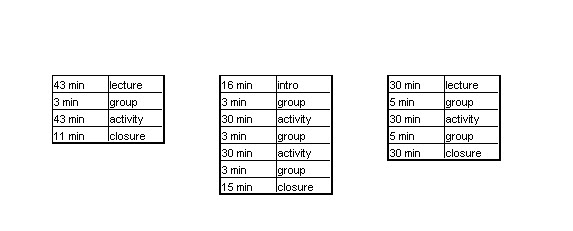
I have found in that for best results for teaching in the block, students perform best when they are provided with the opportunity to change position in the classroom, change partners or groups and are allowed ample opportunity to practice concepts in a variety of methods.  Students tend to understand complex concepts when all parts are presented in a single lesson.  Because material can be practiced within the same time period it is being taught. Practice tends to mean more since students can ask questions and get immediate feedback. Due to this students tend to retain the information for a longer period of time.

Therefore, in designing your lesson plans please try to divide the 90 minute period into sections.  And provide students opportunities to work in different groups within each period.  This will overcome student restlessness and also eliminate interpersonal differences that arise within the class period and might otherwise cause a problem for the entire period.  
 

Lecture                 
  • Present new material.
  • Associate past material to present.
  • Identify key points.
  • Discuss homework.

Activities               

  • Group design/presentations (rules, timelines, presentations, etc...)                           
  • Lab work
  • Demonstrations
  • Handouts/Worksheets
  • Practice
  • Partner teach
  • Concept mapping
  • Jig Saw

Group                    
  • Have several grouping patterns posted so students know their groupings.
  • Allow for several different partners and groups of 3, 4 ,5 or 6  as well large groupings where half the class and a quarter of the class can be grouped.
                               
Closure               
  • This is important for students to have the opportunity to synthesize all sections of the day into one concept and to create the bridge to the next period.                                                      

Keep in mind the students of this generation live in a video world.  Everything is a sound byte, a video clip, all problems are solved in 30 minutes of which 8 minutes are commercials.  It is okay to talk during a movie because you can rewind if you miss something important. Memorizing is not necessary because everything is a click away. Teaching in the style that we learned in is not necessarily the way that these students can or will learn.

Rabu, 02 Maret 2011

Homework: Graded or Ungraded

“By failing to prepare, you are preparing to fail.”
-Benjamin Franklin-

How many runs would home runs would Hank Aaron have been credited with had we kept statistics during every batting practice?  How many perfect practice routines did Nadia Comăneci complete without a judges score?  How many times did Rudolf Nureyev dance Swan Lake without the applause of an audience? Yet the grandeur of their accomplishments and their fame was made possible through the understanding that practice is what allowed them to reach the pinnacle of their performance.

Homework is a natural component of the learning process, just as practice is a natural component of mastering any activity. Whether it is learning a dance, mastering a musical piece or preparing for an athletic event, success is directly related to the effort put in during practice. And yet, no dancer, no musician and no athlete gains credit for their practice except through their actual performance in the event. We do not applaud the dancer or musician during practice. We do not add statistics from practice to the athlete’s record.

The role of homework should be as a "formative" type of assessment. Formative assessments are instructional devices to reinforce the material being learned. Such learning activities should not be part of the student’s grade, because they are essentially viewed as practice. The assessment should actually be of the effectiveness of the teacher’s instruction and in what areas the teacher should continue to provide instruction to assist student mastery.

Homework should be designed to reinforce the concepts discussed during class.  Homework provides an opportunity for the student to practice using the ideas that were presented and discussed during class time and to demonstrate that they are able to apply these ideas to situations not expressly discussed during class time.  Homework allows both the student and teacher to determine if there is understanding of the subject and/or where problems might be found.

Teachers must remember that homework is usually a flawed instructional tool. Grading everything that students do is unnecessary, and grading homework is simply not a best practice. Remind students that they are studying when they do homework and that they will benefit from it by getting better grades on their assessments. Use summative assessments for evaluation.
Things to keep in mind about homework:
  1. Students do not have equal resources for completing homework. (computer or internet, time, study space, privacy etc…)
  2. Homework that is busy work is often copied just for completion.
  3. If homework is summative then it must be graded. Often homework is merely checked off.
  4. Student homework assignments are the most likely to receive zeroes which can negatively skew the total grade that may be indicated by summative assessments.
  5. Homework should never be assigned over holidays thereby interfering with family plans. Kids do need a break.
  6. Many students have nights with hours of homework. Could students more out of 15 or 20 minutes of well planned practice rather than an hour of busy work?
  7. If homework is based on course standards then not doing the homework should naturally affect their grades on summative assessments. For this reason no separate grade should be necessary.
  8. Zeroes in homework followed by zeroes on summative assessments is punishing the student twice for that content.
  9. Failure to complete homework is a responsibility issue, and, as such, should be treated just as inattentiveness, not bringing materials, disruptiveness and similar issues.
  10. Many home help sites have blossomed in the past decade, casting doubt on how much work the student is actually completing.
Homework is a responsibility issue.  Teachers should focus on meaningful practice that assists in student mastery.  Students should create disciplined work habits that enhance their opportunities to maximize their potential.  Homework should be the win-win situation that provides optimum success in the learning environment for both the student and the teacher.

Selasa, 01 Maret 2011

Designing Games for the Three C's

One on the best projects I have found to incorporate all of the Three C's (Thinking Critically, Communicate Clearly and Work Collaboratively) is to have students work in groups to design a game to teach one of the topics we are learning.

I use this assignment primarily in my Anatomy and Environmental Science course, but it could be adapted for any subject.  In Anatomy I have students work in groups of three or four to create a game to teach the anatomy and physiology of the Digestive System from the mouth to the Anus and all of the organs and processes in between.  The Environmental Science students design games to teach a Cycle of Nature: water, carbon, nitrogen, food webs from various biomes.  I teach in a three block schedule of ninety five minunte classes.  I provide students with 30 minutes each day to work with their groups on their games.  Students typically have about three weeks to complete the games, about six class periods.   


Think Critically
Students are asked to design a game with specific rules and an ultimate goal of winning, while focusing on the development of a game that is a teaching and learning tool. Students need to understand the vocabulary, structures, inputs, processes and outcomes of the systems involved. The game must be fun to create a desire to play in order to create the repetition necessary for others to learn from the game play. Students must think critically about how to create a game that will be enjoyable so tha people will want to play it repetitively to increasethe effect of the game as a learning tool.  I encourage students to create games that have variations so that the game can be adapted for various levels of students as a means of introducing the subject, reinforcing learned material or in review for an exam.

Communicate Clearly
Students struggle with the creation of a clear and concise set of rules for their games. They need to communicate their vision for the game in directions and rules that must be prepared for an unknown audience. Most students have little difficulty in verbally explaining how to play a game, but ask them to write the rules and explanations out in a cohesive manner and this can be a cause for great angst for many students.

Working Collaboratively
Coming to a consensus on the game design, delegating responsibilities and producing a finished product demands nothing but a collaborative buy in from the members of the group. Then each student must trust that all aspects of the game come together on Game Day, board, cards, pieces and rules in class and on time.

Game day takes place in our dining hall.  Groups set up their own games and play them for 10 minutes to make sure  games are functional and everything is in place.  They then move about the room playing the other games and grading them.  Students grade the games based upon the effectiveness of the game itself, the effectiveness of the game as a learning tool, and the production quality of the game.  Once students begin playing other games, they are not allowed to return to their own game for any reason. I encourage students to play the games with members of the other groups to maintain perspective and avoid comparisons to only their own games. 
Students will play and score between four and six games during a one hour period.

During the debriefing at the end of the day, I am always amazed at how many students want to be given the opportunity to improve their own game after seeing what others have done and what they might have done to enhance their own.  That is when I see the real learning take place as students evaluate their own work against the work of the peers and demonstrate an honest desire to improve upon their end product.  I typically also see a more focused production quality of the work that is turned in following these projects in both courses.