Tampilkan postingan dengan label Collaboration. Tampilkan semua postingan

Senin, 14 November 2011

Collaborative Learning Teams

COMMUNICATE- COLLABORATE - THINK CRITICALLY

"The strength of the team is each individual member.
The strength of each member is the team."
                                                                 - Phil Jackson

The development of a network of collaborative learning teams within you classroom can create an educational environment where the responsibility for learning lies upon both the students and teacher who comprise that leaning community.

Learners learn by teaching one another. When students teach one another they take ownership of the material by passing it along they actually make it part of themselves. 

The process of teaching one another is by its very nature acive learning.  Student engagement increases the opportunities to learn. 

The saying goes that "Two heads are better than one."  Sharing knowledge creates opportunities for more ideas, alternate approaches, increased possibilites and new perspectives.

Students who have difficulty in the larger classroom may find comfort in smaller groups. This provides avenues for increased communication and the unleashing of ideas that may never be shared in a larger group setting. 

Collaboration brings about an ease and comfort that encourages further attendance in the class as interdependence breeds both responsibility and commraderie. 

Although the goal is increased learning for all, the idea of positive competition among smaller groups may lead to greater problem solving success.

Collaboration encourages the development of leadership skills.

Students who work in groups learn to delegate tasks to maximize group success.

Collaboration increases the development of time mangement skills.    


"Coming together is a beginning, staying together is progress, and working together is success."
                                                             - Henry Ford

Rabu, 09 November 2011

Chaos Towers Revisited

The Conceptual Physics class worked on chaos towers to demonstrate concepts of Physics, Mechanics, Falling Objects, Newton's Law, Potential and Kinetic Energy.

CHAOS WORLD OF MOTION

Teaching Physics Toy - Construction Toy Equipment - Child Construction Toy - Educational Learning Toy


Students work in three groups to construct the chaos towers. They then draw vector diagrams representing velocity of the marble through the track.  Students then identify five concepts from first semester physics and explain how they are represented on the chaos tower.  Lastly, they evaluate each member of their group against the Three C's: collaboration, communication and critical thinking. 


This year one of my students put together a quick video of the chaos towers in action. 


Selasa, 03 Mei 2011

CHAOS is an Opportunity to LEARN

"Chaos in the world brings uneasiness, but it also allows the opportunity for creativity and growth."
 - Tom Barrett -

Do you remember Lincoln Logs, Tinker Toys, Erector Sets, Blocks and the Original Legos?
How much did we learn about the basic components of logic, building and physics from the trial and error of playing with these toys both correctly and in some cases incorrectly.  I know I learned about catapults by launching the single notch lincoln logs using the green roof plank as a lever.  I learned about control over the center of gravity by building towers of blocks and unbalanced lego creations. I learned gear and wheel ratios from tinker toys and erector sets.  While I didn't realize I was learning physics, I came to understand physical phenomena through tinkering and experimentation.

In my Physics class I use Chaos Towers ( http://www.chaostoy.com/ ) to allow students to experience the hands on nature of discovering the physics of Newton's Laws, Poential (gravitational) and Kinetic Energy and the basic ideas behind vetors as a means of mapping motion, displacement, velocity and acceleration. 


  I have three chaos towers in my classroom.  I divide students into three teams and give them two class periods to build the towers.  The towers can be built horizontally and vertically.  I make sure at least one of the towers is built horizontally.  The students prefer the vertical version.

The lessons students learn, even before the concepts of physics are the importance of reading and following directions and the job of delegating the work.  I have students grade each other on their contribution to the building of the tower and collaboration and communication within the group. 
 
Once the towers are built, students analyze directional changes and displacement values of the path of the marbles.  Students determine the gravitational potential energy at various points along the path and compare velocities based upon the PE = KE formula and measured velocities. The trampoline offers students the understanding of action and reaction forces as well as the parabolic arc of a projectile. 

On the Chaos Toy website there a several lessons utilizing smaller component portions of the towers. http://www.chaostoy.com/cd/html/defau_e.htm

The hands on nature of the tower and the collaborative aspects of the group work, provide a tremendous learning environment for my students.


"I have great belief in the fact that whenever there is chaos, it creates wonderful thinking. I consider chaos a gift."
   

Senin, 02 Mei 2011

Collaborative Group Techniques

'A teacher cannot build a community of learners unless the voices and lives of the students are an integral part of the curriculum.'              
                                                    --  Peterson  --

Using collaborative groups can be very challenging.  The students must value the process of learning and understand that within the classroom environment they are responsible to each other and for each other as members of that learning community.  With that in mind, students must be accountable to the group, to be prepared and to share equally in the learning process.  Students should understand that collaborative groups are not an opportunity to socialize and most definitely not an opportunity to let others do all the work.  Each member of the group must pull their own weight in order for the success of everyone. 


Playing Teacher
Divide students into even groups of five or less. Give each student in a group a unique concept to learn. Then bring the group back together and let students teach each other what they have learned. Make sure that the entire group is learning about the same subject, just a different aspect of the subject. Test each group when the teaching session is completed within each group.

The Interview.
Divide students into groups with an even number of students in each group. Each member of a group chooses a partner. Have individuals interview their partner by asking them clarifying questions. Now let the partners switch roles. Lastly, let members of the entire group share their responses as a team.

Catch a Brainstorm.
Divide students into teams of 4 to 6, and appoint one student on each team to be the "secretary." Give each team a different question that can have many answers. Now give each team a chance to brainstorm answers to the question, with the "secretary" writing down the team's responses. Have the students work in a circle, each taking turns to give a response, instead of having all of the students shout out answers to the "secretary" at once.

Number Frenzy.
Divide students in groups of four. Label each student in a group as number 1, 2, 3, or 4. Ask the groups a common question. The group then works together to come up with the correct answer. Now you call out a number (between 1 and 4), and the person in a group that is assigned that number is to give you the answer to the question.

Group Grading.
After taking a test, divide your students into groups with an even number of people in each group. Let students trade their test papers, so they will be grading each other. Now give each group a few minutes to determine which answers are correct and to see which group members may have made mistakes. Allow the groups time to explain so that those members can see why their answer was wrong and what the correct answer should have been. Wrap up the groups and answer any dangling questions not addressed in the individual groups.

The Great Debate.
Cooperative learning can be used in any situation where you want students to debate the points of view of a concept being taught. For instance, when learning about the elections process, you can divide students into groups and have them hold a debate over what they would change about the elections process, what is working and not working with the current process, etc.

Listing Activity.
Divide students into groups of five or less. Ask each group to list words and/or phrases that describe what they are being taught, i.e., Energy, heat, potential, light, kinetic… Be sure that every response is written down that each individual gives. Have each group discuss their list and then come up with the words and/or phrases the entire group agrees on. Later each group can get up before the class and discuss why they chose the responses they did.

The One Minute Game.
Divide the class into teams of five or less. Have each group contemplate answers to these questions, giving them one minute to answer them:
What was the main thing you learned today?
Tell me two questions that you have remaining about this lesson.
What else would you like to know about this topic?
This is a great cooperative learning activity that helps students give you feedback about the lessons they learned.

Assigning Group Roles
Consider assigning each member of a group a role, so each member feels they are contributing to the group in a positive way. Roles could consist of:
Leader - The individual that makes sure everyone in the group has mastered the concepts being learned through the exercises.
Secretary - The person who records responses for the entire group.
Reporter - The person that speaks for the group when standing in front of the class.
Monitor - The person who keeps time for the group with timed assignments.
Manager - The person who fills in for any member of the group who is absent, and assists the leader of the group.
Roles can be switched within a group from time-to-time. Allow students to critique the performance of each member of the group.  This will hold them accountable to each other.  Read the critiques and provide feedback to let students know how their team members view there contributions.  

Ranking order.
Determine whom you will put into groups by using the following exercise.

1. Present your students with an issue that is pertinent to a lesson. Have the students rank this issue by how they feel about it with 1 being in strong agreement and 10 being in strong disagreement.
2. Place a rank-order line on your whiteboard and record the students' responses on the line.
3. Now form your groups by pulling out one person from each end of the ranking order, and then two people from the center of the line.

Kamis, 03 Maret 2011

Teaching in the Block

Are you
The Sage on the Stage
or
The Guide on the Side

“Teachers should guide without dictating, and participate without dominating.“
C.B. Neblette

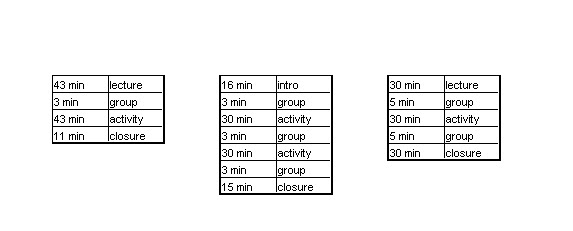
The greatest detriment to the block schedule is the teacher who refuses to vary methodologies.  Concerns raised by students include statements like  “90 minutes of Teacher ‘X’ will drive me nuts.”, “Teacher “Y” only lectures, I can’t sit still for that long.” 

I have found in that for best results for teaching in the block, students perform best when they are provided with the opportunity to change position in the classroom, change partners or groups and are allowed ample opportunity to practice concepts in a variety of methods.  Students tend to understand complex concepts when all parts are presented in a single lesson.  Because material can be practiced within the same time period it is being taught. Practice tends to mean more since students can ask questions and get immediate feedback. Due to this students tend to retain the information for a longer period of time.

Therefore, in designing your lesson plans please try to divide the 90 minute period into sections.  And provide students opportunities to work in different groups within each period.  This will overcome student restlessness and also eliminate interpersonal differences that arise within the class period and might otherwise cause a problem for the entire period.  
 

Lecture                 
  • Present new material.
  • Associate past material to present.
  • Identify key points.
  • Discuss homework.

Activities               

  • Group design/presentations (rules, timelines, presentations, etc...)                           
  • Lab work
  • Demonstrations
  • Handouts/Worksheets
  • Practice
  • Partner teach
  • Concept mapping
  • Jig Saw

Group                    
  • Have several grouping patterns posted so students know their groupings.
  • Allow for several different partners and groups of 3, 4 ,5 or 6  as well large groupings where half the class and a quarter of the class can be grouped.
                               
Closure               
  • This is important for students to have the opportunity to synthesize all sections of the day into one concept and to create the bridge to the next period.                                                      

Keep in mind the students of this generation live in a video world.  Everything is a sound byte, a video clip, all problems are solved in 30 minutes of which 8 minutes are commercials.  It is okay to talk during a movie because you can rewind if you miss something important. Memorizing is not necessary because everything is a click away. Teaching in the style that we learned in is not necessarily the way that these students can or will learn.

Rabu, 09 Februari 2011

Lessons From Geese


I use the You Tube video "Lessons From Geese"  in all of my classes to introduce the concept of collaboration and cooperation in my classroom.  I stress the importance of developing a teaching/learning relationship among the students in my classroom.  I try to eliminate the concept of competition for grades.
I want the students to help each other to learn and encourage the idea that all students can achieve success. The teaching/learning concepts of Dr. Gary Phillip's are further developed in understanding that when students teach each other they actually improve their own understanding of the material. 
I go to great lengths to explain the difference between cheating and actually assisting students to understand as a means of improving the learning process for everyone.

T  -  Together
E -   Each 
A -   Achieve
M -  More 

Once a coach, always a coach.